
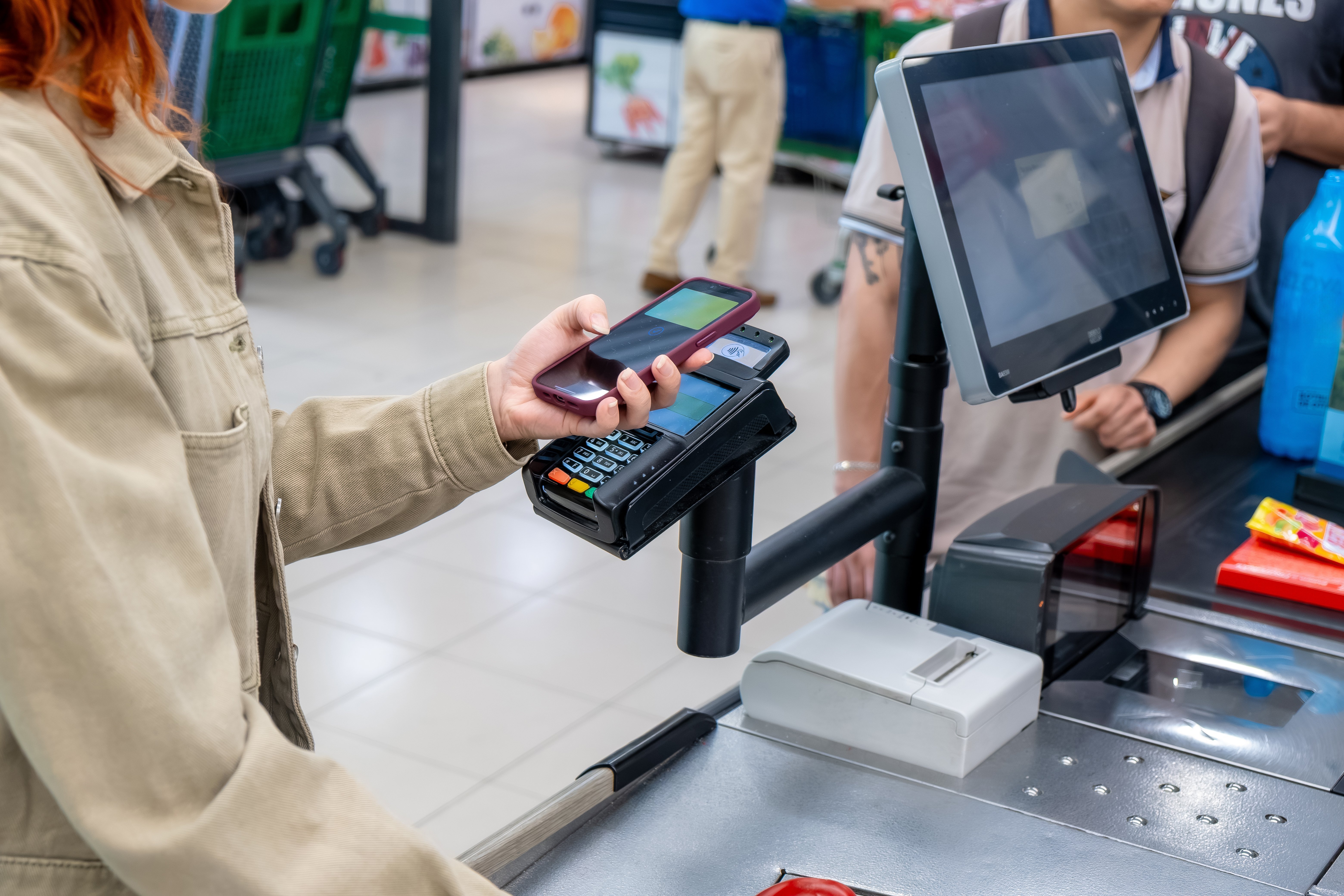
When the card terminal at your counter isn't connected to your point-of-sale (POS) system, every card sale gets entered twice. The cashier rings up the sale, then keys the same total into the terminal. Most days the two numbers match. When they don't, because of a typo, an item added at the last second or a void on one machine but not the other, someone has to track down the difference later.
Windward System Five removes that second entry. With integrated card payments, System Five sends the sale total to the card terminal, and the terminal sends the approval back to System Five automatically.
What are integrated card payments?
Integrated card payments mean your POS system and your card terminal talk to each other. The terminal, often called a PIN pad, is the device where the customer taps, inserts or swipes their card. In an integrated setup, System Five tells the PIN pad how much to charge, and the PIN pad tells System Five whether the payment was approved.
In the U.S. and Canada, System Five works with our preferred payment processors, including Worldpay and Global Payments, through NETePay by Datacap Systems. NETePay is the payment software that links System Five to your payment processor. Integrated processing is also what lets System Five apply payment fees and surcharges at the counter.
Integrated card payment features in System Five
System Five handles the card situations every counter runs into.
Chip and PIN security
System Five supports fully integrated chip and PIN. Chip and PIN, also known as EMV, is the card security standard, named for Europay, Mastercard and Visa, the companies that created it. EMV creates a unique code for each purchase, which makes a copied card much harder to use.
Handle cards that won't read
Every counter sees cards that won't read from time to time. On System Five, staff can key in a card with its authorization code, and System Five records the payment for the sale like any other. If a card was approved outside the system entirely, you can still attach that approval to the sale afterward.
Troubleshoot PIN pad problems
When a PIN pad stops working, System Five's EMV reporting and diagnostics give your staff, or our support team, real details to check. That shortens the time between noticing a problem and taking cards again.
If your entire payment processor is down, System Five lets you keep taking cards through the outage. When the PIN pad can't reach the processor, store-and-forward saves card payments and sends them once the connection is back. Store-and-forward also works with System Five on Cloud, because it runs on the PIN pad itself.
Those saved payments are approved only after they're sent, so check your processor's rules and limits for store-and-forward before you rely on it.
Quest Eftpos processing for Australian stores
Eftpos, short for electronic funds transfer at point of sale, is Australia's debit card system. Australian stores can use Quest Eftpos processing in System Five for integrated credit and debit payments.
Choose how deeply your POS payments integrate
"Integrated" can mean different levels of connection. With a semi-integrated terminal, System Five and the PIN pad pass amounts and results back and forth, but card details go straight from the PIN pad to the processor. For most stores, that's the right balance of convenience and security requirements.
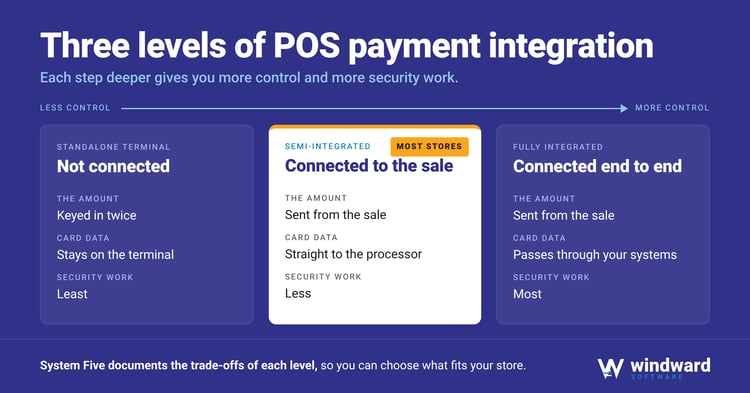
Deeper integration gives you more control, but it also brings more security obligations. System Five documents the trade-offs of each option, so ask about integration depth in your demo and choose the level that fits your store.
One card connection for every register
Whichever level you choose, System Five uses shared network card authorization. Every register sends card payments to your payment processor through one shared connection, so you maintain one integration and check one place when something goes wrong, no matter how many registers you open.
How integrated payments help the back office
 Because card payments are synced with each sale instead of retyped, the day's card total in System Five matches the processor's.
Refunds follow the same path. When you process a return at the counter, System Five credits the card through the same connection, so the return and the refund stay in one record. "RMA management made simple" covers return workflows in more detail.
Questions to ask about any integrated POS payment system
These questions show how well a vendor's payment integration holds up in daily use.
Does the POS send the amount to the PIN pad for every type of payment? Some systems fall back to keying for refunds, deposits or payments on account. In System Five, the amount comes from the sale, and refunds go back through the same integration.
What happens when the processor goes down? System Five supports store-and-forward, so your counter can keep taking cards during an outage.
What tools help when a PIN pad stops working? System Five includes EMV diagnostics and reporting, which your staff and our support team can both use.
How deeply does the payment system integrate, and what security work does that put on your store? System Five supports a variety of integration levels and documents the trade-offs of each option.
Does every register use the same card connection? Yes. Shared network card authorization runs every register through one connection, on System Five.
To see which other System Five features fit your business, check out the fit finder.
Book a demo today
If your staff still key card totals into a separate terminal, book a demo. Bring your questions about processors, integration depth and outages, and we'll show you how System Five handles each one.

Share this article on